Introduction
You’ve already mixed your first batch of resin. You’ve felt that satisfying moment when pigment swirls through a clear pour, watched bubbles rise to the surface, and peeled back your mold to reveal something you made with your own hands. You’re hooked — and we get it.But even experienced resin artists hit walls. Cloudiness that won’t go away. Sticky surfaces that never fully cure. Ratios that feel right but aren’t. Before you dive into advanced techniques, it’s worth revisiting the fundamentals — because in resin art, the basics aren’t just the beginning. They’re the foundation of everything.
What Exactly Is Epoxy Resin?
Epoxy resin is a two-part polymer system — a resin (Part A) and a hardener (Part B) that, when combined in the right ratio, undergo a chemical reaction called curing. This reaction transforms a liquid into a solid, durable, glass-like material.
Unlike UV resin (which cures under ultraviolet light), epoxy resin cures through a chemical process called polymerization — and this process is highly sensitive to temperature, humidity, and mixing accuracy.
At Radi Kraft, our epoxy resin is formulated for:
- Crystal-clear, high-gloss finish
- Low viscosity for easy pouring and bubble release
- UV resistance to prevent yellowing over time
- Food-safe certification on select grades
The Chemistry You Need to Know (Without the Chemistry Degree)
The Ratio Is Non-Negotiable
Every epoxy resin product has a specific mix ratio — commonly 1:1 or 2:1 (resin to hardener by volume or weight). Radi Kraft epoxy uses a 1:1 ratio by volume.
Getting this wrong — even slightly — means:
- Excess resin = sticky, soft, or tacky final product
- Excess hardener = brittle, cloudy, or cracked surface
Pro tip: Always measure by weight using a digital scale for the most accurate results, especially for small batches.
The Exothermic Reaction
When resin and hardener meet, they generate heat. This is normal — but if your mixture gets too hot (especially in large volumes), it can:
- Cure too quickly
- Warp or crack
- Yellow prematurely
- In extreme cases, smoke or crack the mold
Keep your pours thin (under 6mm at a time for standard resin) and work in a cool, well-ventilated space.
Temperature and Humidity: The Hidden Variables
This is where most intermediate artists make their biggest mistakes.
Ideal Working Conditions:
- Temperature: 24°C–30°C (75°F–86°F)
- Humidity: Below 50%
Cold temperatures slow the cure and can cause cloudiness. High humidity introduces moisture into the chemical reaction, leading to a blush effect — a milky, waxy film on the surface that ruins the finish.
If you’re working in India’s monsoon season, this is especially important. Run an air conditioner or dehumidifier in your workspace before and during your pour.
Mixing: The Step Most People Rush
Here’s the truth: improper mixing is the #1 cause of resin failures.
The Right Way to Mix:
- Measure Part A and Part B separately into clean, dry cups
- Combine into a third clean cup (this is your “mixing cup”)
- Stir slowly for 3–5 minutes, scraping the bottom and sides
- Transfer to a fresh cup and stir for 1–2 minutes more
The second cup transfer is critical — it ensures you’re not working with unmixed resin stuck to the walls of your original cup.
Stir slowly to minimize bubble introduction. Fast, vigorous stirring traps air and creates more work later.
Working Time vs. Cure Time
These are two different things — and confusing them causes problems.
| Stage | What It Means | Typical Timeframe |
|---|---|---|
| Pot Life / Working Time | How long you have to work with the resin before it begins gelling | 30–45 minutes |
| Demold Time | When you can safely remove from the mold | 12–24 hours |
| Full Cure | When resin reaches maximum hardness | 48–72 hours |
Don’t sand, coat, or stress your piece until it has fully cured. Rushing this step leads to soft spots and surface damage.
Common Problems and What They Actually Mean
Sticky Surface After 24 Hours
- Likely cause: Incorrect mix ratio or unmixed resin
- Fix: Allow more cure time; if still tacky after 72 hours, the batch needs to be sanded off and recoated
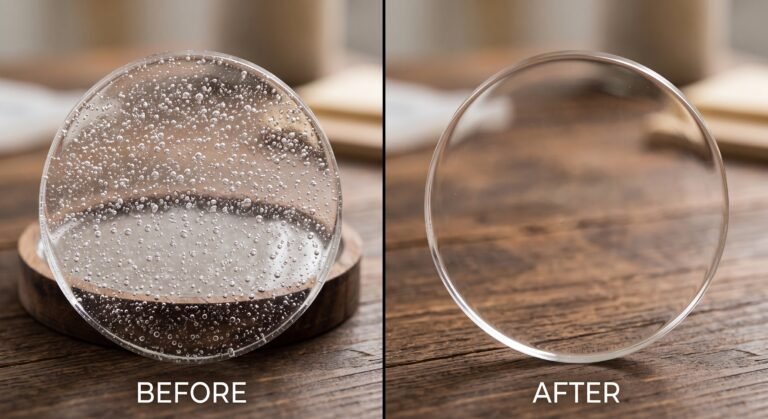
Cloudiness or Milky Finish
- Likely cause: Moisture/humidity exposure or over-mixing with trapped air
- Fix: Work in a controlled environment; use a heat gun or torch to pop surface bubbles
Yellowing Over Time
- Likely cause: UV exposure or low-quality resin
- Fix: Use Radi Kraft’s UV-resistant epoxy for outdoor or light-exposed projects; apply a UV-protective topcoat
Resin Not Hardening (Remains Liquid)
- Likely cause: Wrong ratio or expired hardener
- Fix: This batch cannot be saved; proper ratio is essential
Why the Quality of Your Resin Matters More Than You Think
Not all epoxy resin is created equal. Low-cost alternatives often compromise on:
- Clarity — slight yellow tint even when new
- BPA content — food safety concerns
- UV stabilizers — yellowing within weeks
- Viscosity consistency — batch-to-batch variation makes results unpredictable
Radi Kraft’s epoxy resin is tested for consistent viscosity, clarity, and UV stability — so your results are repeatable, not a gamble.

Quick Reference: Resin Basics Cheat Sheet
| Parameter | Ideal Value |
|---|---|
| Mix Ratio | 1:1 by volume |
| Working Temperature | 24°C – 30°C |
| Humidity | Below 50% |
| Mixing Time | 4–7 minutes total |
| Working Time | 30–45 minutes |
| Demold Time | 12–24 hours |
| Full Cure Time | 48–72 hours |
| Max Pour Depth (per layer) | 6mm |
What’s Next?
Once you’re confident in your fundamentals, the world of resin art opens up: ocean wave pours, geode art, resin jewelry, functional home décor, table tops, and more. Every advanced technique depends on a solid understanding of the basics.
At Radi Kraft, we’re here to support your craft journey — from your very first pour to your hundredth. Explore our range of epoxy resin kits, pigments, and tools designed for artists who take their work seriously.
Have questions about your resin project? Drop them in the comments or reach out to us directly. Happy crafting!
— The Radi Kraft Team

❓ FAQs — Epoxy Resin Basics
Q1. What is the correct mixing ratio for epoxy resin?
Most epoxy resins, including Radi Kraft’s, use a 1:1 ratio by volume (equal parts resin and hardener). Always measure accurately — even a small imbalance can cause sticky or uncured results.
Q2. How long does epoxy resin take to cure completely?
Epoxy resin has three stages:
- Working time: 30–45 minutes
- Demold time: 12–24 hours
- Full cure: 48–72 hours
Do not sand or coat until fully cured.
Q3. Why is my resin still sticky after 24 hours?
This is usually caused by an incorrect mix ratio or insufficient mixing time. Make sure you mix for at least 4–7 minutes, scraping the sides and bottom of the cup thoroughly.
Q4. Can I use epoxy resin in humid weather?
High humidity (above 50%) can cause a milky or cloudy finish called “blush.” It’s best to work in an air-conditioned or dehumidified space, especially during India’s monsoon season.
Q5. Why is my resin turning yellow?
Yellowing is caused by UV exposure or use of low-quality resin without UV stabilizers. Radi Kraft’s epoxy resin is UV-resistant to prevent premature yellowing. For outdoor projects, always apply a UV-protective topcoat.
Q6. What is the maximum pour depth for epoxy resin?
For standard epoxy resin, keep each layer under 6mm. Thicker pours generate excess heat (exothermic reaction) which can crack, warp, or yellow the resin.
Q7. Is Radi Kraft epoxy resin food safe?
Select grades of Radi Kraft epoxy resin are food-safe certified. Check the specific product listing for food-safety details before use on cutting boards, coasters, or serving trays.
Q8. What temperature is best for working with epoxy resin?
The ideal working temperature is 24°C–30°C (75°F–86°F). Cold temperatures slow curing and cause cloudiness; very hot temperatures speed up the reaction and reduce working time.
Q9. Can I fix a cloudy or milky resin surface?
Light cloudiness from bubbles can be fixed with a heat gun or torch during the working time. If cloudiness is due to humidity or improper mixing, you may need to sand the surface and apply a fresh topcoat layer once fully cured.
Q10. Where can I buy good quality epoxy resin in India?
Radi Kraft offers high-quality, UV-resistant, crystal-clear epoxy resin online in India — available in multiple sizes for hobbyists and professional artists alike.